
THE PROJECT
The hard lesson from the Morandi Bridge collapse has evidenced how important is the monitoring and assessment of structural health during the RCS service life. Economic, political, and social implications related to the safety of reinforced concrete structures and infrastructures pose significant and unavoidable challenges. Deterioration phenomena affecting concrete and/or reinforcements cause physico-chemical and mechanical variations, difficult to detect and localize by using conventional diagnostic tools and methods, which are often invasive, cost and time-consuming. Numerical modeling supports the safety condition assessment of RCS but to date there isn’t a consolidated approach for modeling deteriorated materials.
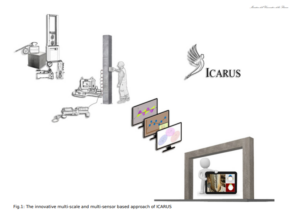
Coupled with semi-destructive and destructive tests (DT) and/or other well-known non-destructive tests (NDT), geophysical methodologies can play a fundamental role in RCS inspecting and monitoring. Nowadays, protocols for the diagnosis of deteriorated RCS are not fully established, as they depend on the specificity of the case studies under investigation. Moreover, the potentialities of geophysical methodologies, alone or integrated, are not fully unleashed. Their systematic implementation in RCS diagnostics is not established yet. Moreover, the outcomes of geophysical methodologies may significantly improve the FEM-based structural assessment of deteriorated RCS. ICARUS aims at exploring the contribution that geophysical methodologies can give for detecting and monitoring the main degradation phenomena affecting RCS, considering both the concrete and the reinforcements deterioration. By adopting an innovative multiscale and multisensory based methodology (fig.1), empirical relationships between geophysical and mechanical parameters in different deterioration conditions will be assessed. Indeed, ICARUS will develop an innovative strategy based on the integration of geophysical analyses, conventional NDT and DT, and advanced statistical analyses, to identify the material decay evolution and upgrade existing corrosion damage models.
In addition, novel structural assessment approaches for deteriorated RCS will be proposed. At this aim, improved bond-slip and tension-stiffening laws will be developed for assessing how corrosion affects the steel-to-concrete interaction at both local and global level. The outcomes, coupled to empirical relationships based on geophysical measurements for cracked concrete and corroded reinforcements, as well as proper finite element approaches, will allow the evaluation of the structural behaviour of deteriorated RCS.
Thanks to ICARUS, new perspectives will be given to non-invasive diagnostic tools for estimating the structural performance of deteriorated RCS, and new insights into the RCS structural health preservation and monitoring.